


Hugo Manuel Gonçalves da Silva
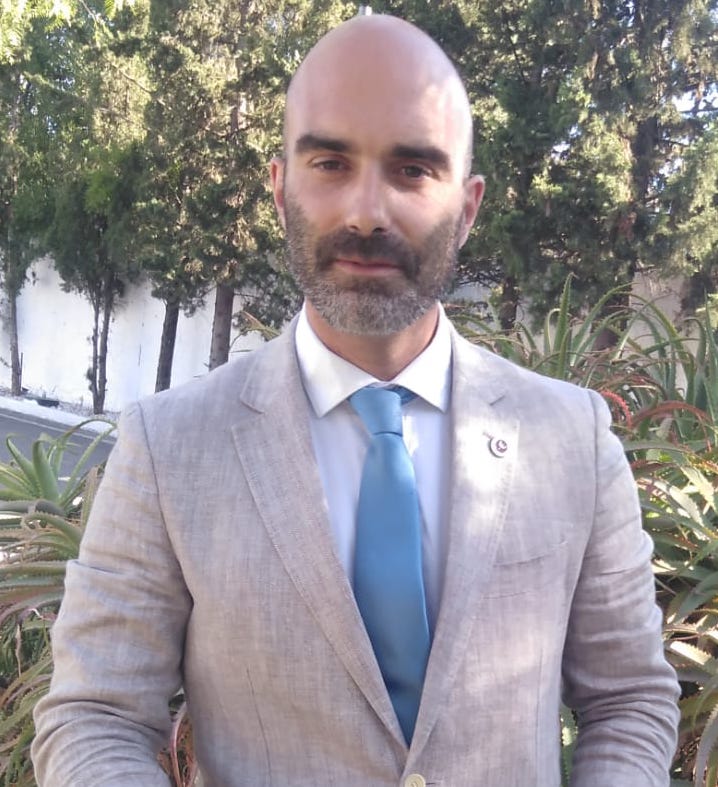
Hugo Manuel Gonçalves da Silva
Bio
I have now reached 71 published research papers (h-index 21 and total of 1295 citations) and I am Project Coordinator of the Horizon Europe Project: H2tALENT - Alentejo Green Hydrogen Valley delivering integrated full-chain sustainable hydrogen ecosystem with technical, economic, social and environmental benefits and superior upscaling/replicability and Deputy Director of the Physics Department of the University of Évora.
Since 2019 I became Assistant Professor at the Physics Department of the University of Évora, lecturing Energy related courses (photovoltaics, and energy storage, mainly), and I have graduated two PhD students. Furthermore, I become co-Director of INEGI Alentejo which aims to serve as a technological development interface between research and the industry, with special focus on the development of composite materials for the aeronautic sector, but as well in semiconductor and Energy sectors.
From 2015 to 2019, I was Assistant/Principal Researcher at the Renewable Energy Chair, University of Évora, working on Solar Energy along two streams of activities: 1) Executive management of the Evora Molten Salt Platform (EMSP) in collaboration with German Aerospace Centre (Deutsches Zenrum für Luft- und Raumfahrt, DLR). EMSP is a 3.6 MW experimental Solar Thermal Parabolic Through Plant using molten salts as the fluid converting solar energy into heat. The completion and operation of this platform brings together key industrial players: Eltherm, innogy SE, Grupo TSK, Rioglass, Yara and Steinmüller. The overall investment in this plant to that date stood at over € 15 million; 2) Research leadership of the Solar Irradiance and System Operation group, which focused on instrumentation test and implementation, elaboration of performance tests, solar resource assessment, electrical production forecasts and development of soiling assessment and mitigation tools, all towards a more efficient operation of solar thermal power plants.
From 2010 to 2014, I was a Post-Doc at the former Geophysical Centre of University of Évora (now integrated to the Institute of Earth Sciences) where I focused my work on Atmospheric Electricity. In the first year, I won a prestigious award for early career researchers from Calouste Gulbenkian Foundation to study electromagnetic earthquake precursors; perturbations on the atmospheric electric field were detected around 3 days before an earthquake happened. Moreover, the electric properties of rocks were examined revealing a known confined water phase transition, at low temperatures, but unknown to occur in rocks. The last two years were dedicated to the creation of a Laboratory of Atmospheric Electricity that engaged 5 researchers including me. This was a very intensive period of scientific production in which we were able to explore: 1) urban pollution phenomena - during the 80’s pollution levels at Lisbon were inferred from atmospheric electric field data of that period; 2) solar-earth interactions - similarities between sunspot number, neutron counts and atmospheric electric field time-series were found supporting solar magnetic activity influence on Earth’s climate, a factor disregarded in climate models. Over the same period, I was also a visiting researcher at the University of Bristol, and worked closely with the University of Reading, both from the UK.
From 2006 to 2009, I was a PhD student at the Institute of Physics for Materials of University of Porto, Portugal studying spin-dependent electronic transport in nanostructures - Spintronics - the technology behind hard disk drive’s reading heads.
